Leave Your Message
Choosing the China Best Cable Assembly Manufacturer for Global Buyers requires more than comparing unit prices. It demands evidence from the factory floor, not polished claims on a website. Buyers should examine Cable Assembling methods, material control, testing records, and communication practices before approving a supplier. Details matter.
A dependable manufacturer should explain how wires are stripped, crimped, labeled, bundled, and inspected. Ask for samples with matching terminals, conductor sizes, insulation colors, and connector tolerances. Look for practical quality controls, such as pull-force testing, continuity checks, insulation resistance testing, and visual inspection under clear lighting. These steps help prevent loose crimps, reversed wires, and damaged jackets in the field. Small failures spread.
Experience also appears in documentation. A professional supplier can provide drawings, inspection reports, change-control records, and traceability for critical materials. International buyers may need support with packaging, export coordination, engineering changes, and production schedules. Reliable communication matters when a prototype becomes a monthly order. Silence creates risk.
However, no supplier is perfect. Samples can perform well while mass production reveals variation. That gap matters. Buyers should use staged approvals, independent inspections, and realistic acceptance criteria. Certifications may support confidence, but they do not replace process audits or product testing. A transparent manufacturer welcomes difficult questions and admits limitations early. This article examines the capabilities, quality practices, customization options, and service standards that global buyers should consider when selecting a Chinese cable assembly partner. The goal is not to promise perfection, but to identify dependable evidence before production begins.
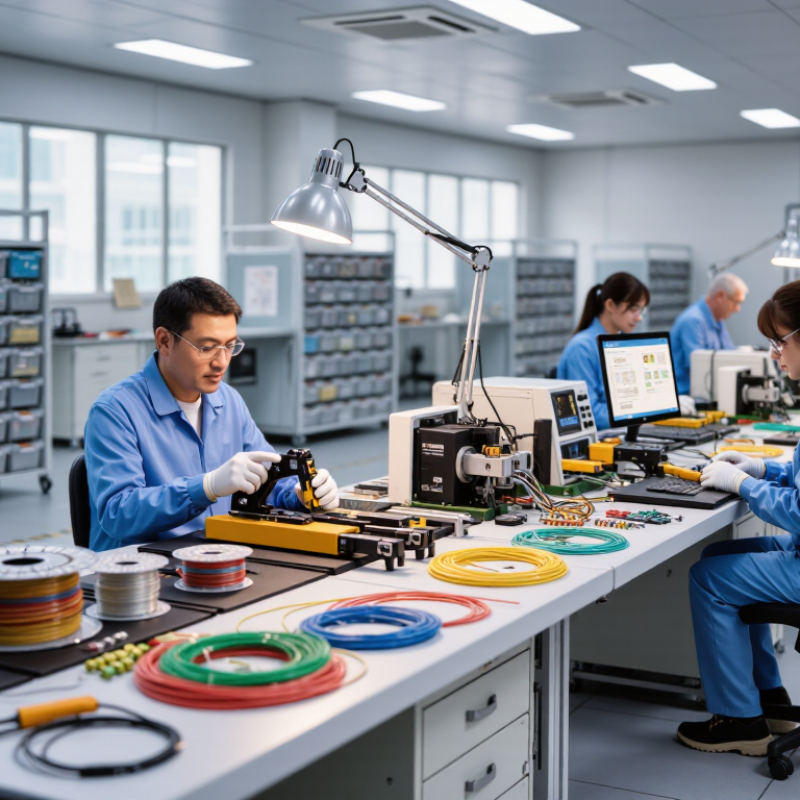
China’s cable assembly manufacturing covers more than wire cutting and connector fitting. It includes engineering review, material selection, automated processing, testing, packaging, and delivery control. A 2024 Fortune Business Insights report valued the global cable assembly market at about USD 167 billion. This demand reflects automotive, telecommunications, industrial equipment, medical devices, and consumer electronics.
The manufacturing scope usually begins with a customer drawing or sample. Engineers check conductor size, insulation material, bending radius, shielding, and connector compatibility. On the production floor, operators may strip wires, crimp terminals, solder contacts, overmold joints, and apply identification labels. Crimp height and pull-force results should be recorded. Continuity, insulation resistance, and dielectric withstand tests provide stronger evidence than visual inspection alone.
Standards matter.
IPC/WHMA-A-620 defines widely used acceptance requirements for cable and wire harness assemblies. A reliable Chinese manufacturer should connect these requirements with controlled work instructions, calibrated equipment, traceable materials, and documented final inspection. Experience shows that small details can cause large failures, such as a partially seated terminal or excessive bending near a connector. The boundary between assembly and system integration is not always clear. Some suppliers also provide prototype builds, fixture design, and functional testing. That broader scope can reduce buyer workload, but it may increase communication risks. Drawings still need review. Human judgment is not perfectly replaceable.
| Dimension | Definition or Manufacturing Scope | Common Technical Data | Global Buyer Considerations |
|---|---|---|---|
| Product Definition | A cable assembly is a finished electrical or data-transmission unit made by combining one or more cables with connectors, terminals, contacts, backshells, overmolds, labels, or protective sleeving. | May be supplied as a single-ended cable, double-ended cable, multi-branch harness, ribbon cable assembly, or shielded cable assembly. | The buyer should define the electrical, mechanical, environmental, and regulatory requirements before requesting quotations. |
| Core Manufacturing Processes | Manufacturing commonly includes wire cutting, stripping, crimping, soldering, terminal insertion, connector assembly, labeling, bundling, testing, and final inspection. | Process controls may include crimp-height checks, pull-force testing, continuity testing, insulation-resistance testing, and visual inspection. | Ask for process flow diagrams, control plans, inspection records, and traceability procedures for production lots. |
| Conductor Options | Assemblies can use stranded copper, tinned copper, bare copper, silver-plated copper, nickel-plated copper, or other application-specific conductors. | Common conductor sizes range from fine-wire applications such as approximately AWG 30 to higher-current applications around AWG 4; the suitable size depends on current, voltage drop, flexibility, and temperature. | Conductor material and cross-sectional area should be selected according to current capacity, bending cycles, corrosion exposure, and applicable standards. |
| Insulation and Jacket Materials | Cable assemblies may use PVC, PE, XLPE, TPU, TPE, silicone rubber, PTFE, FEP, or other engineered insulation and jacket materials. | Material selection affects flexibility, temperature resistance, chemical resistance, abrasion resistance, flame performance, and outdoor durability. | Specify the operating temperature, bend radius, chemical exposure, UV exposure, flame rating, and installation environment. |
| Connector and Termination Types | Termination methods include crimping, soldering, insulation-displacement connection, screw termination, press-fit connection, and molded termination. | Connector selection is determined by pin count, pitch, current rating, voltage rating, mating cycles, sealing level, locking method, and mounting arrangement. | Provide connector drawings, terminal specifications, mating-part information, and required insertion or retention performance. |
| Signal and Power Applications | Cable assemblies can be designed for low-voltage power, control signals, sensors, industrial communication, networking, audio/video, medical equipment, and instrumentation. | Electrical requirements may include rated voltage, continuous current, impedance, capacitance, attenuation, shielding effectiveness, and signal integrity. | For data applications, specify transmission category, frequency range, impedance, insertion loss, return loss, and required test method. |
| Shielding and Grounding | Shielded assemblies use foil, braid, spiral shielding, drain wires, conductive layers, or combinations of these methods to reduce electromagnetic interference. | Shielding performance depends on coverage, termination quality, grounding design, cable geometry, and the operating frequency. | Define whether the shield is terminated at one end or both ends and identify the required grounding and EMC test conditions. |
| Environmental Protection | Protection may be achieved through sealed connectors, heat-shrink tubing, potting, overmolding, grommets, braided sleeving, and strain reliefs. | Ingress protection levels such as IP54, IP65, IP67, or IP68 may apply when the complete assembly is tested under the relevant conditions. | An IP rating applies to a defined configuration and test method; it should not be assumed solely from the connector or cable specification. |
| Temperature and Mechanical Performance | The assembly must withstand its intended temperature, vibration, shock, flexing, tensile load, torsion, and installation conditions. | Typical cable materials may support operating ranges such as approximately -40°C to +105°C or higher, but the actual limit is determined by the weakest component. | Define static or dynamic bending, minimum bend radius, flex-cycle requirements, cable routing, vibration profile, and strain-relief requirements. |
| Quality and Workmanship Standards | Manufacturing quality is commonly controlled through documented work instructions, inspection plans, sampling procedures, and workmanship criteria. | IPC/WHMA-A-620 is widely used as a workmanship reference for cable and wire harness assemblies; acceptance criteria should be agreed in writing. | Specify the applicable revision, class, inspection level, defect classification, and documentation package. |
| Product Safety and Compliance | Compliance may involve electrical safety, flammability, restricted substances, chemical content, and market-specific documentation. | Common references include UL 758 for appliance wiring material, RoHS, REACH, and relevant IEC or national electrical standards, depending on the application. | Compliance is application- and market-specific. Confirm whether certification applies to the cable, connector, complete assembly, or end product. |
| Testing and Inspection | Testing verifies electrical continuity, isolation, termination quality, dimensions, polarity, labeling, and mechanical integrity. | Typical tests include continuity, short-circuit detection, insulation resistance, dielectric withstand, contact resistance, pull force, and dimensional inspection. | The test plan should identify 100% tests, sample tests, test voltage, test duration, acceptance limits, and calibration requirements. |
| Customization and Engineering Support | Manufacturing scope may include design-for-manufacturing review, prototype builds, drawing conversion, sample approval, tooling, and engineering changes. | Required inputs may include 2D drawings, 3D models, wiring diagrams, bill of materials, cable length, strip length, terminal orientation, and labeling instructions. | A complete technical package reduces quotation errors, production variation, rework, and approval delays. |
| Production Volume | Cable assembly manufacturing can support prototype, low-volume, medium-volume, and recurring production programs. | Automation level is influenced by wire type, connector design, annual demand, product variation, cycle time, and tooling cost. | Discuss minimum order quantity, pilot-lot size, forecast flexibility, capacity planning, and change-control procedures. |
| Packaging and Logistics | Finished assemblies may be individually bagged, coiled, tray-packed, wound on reels, or placed in returnable packaging according to geometry and shipping needs. | Packaging should prevent kinking, terminal damage, contamination, moisture ingress, electrostatic damage, and mixing of different part numbers. | Define carton labeling, lot identification, quantity per package, moisture protection, pallet requirements, and export documentation. |
| Cost Drivers | Pricing is influenced by raw materials, connector count, cable length, labor content, tooling, testing, packaging, order volume, and compliance requirements. | Labor-intensive operations include manual crimping, soldering, branching, overmolding, complex testing, and detailed inspection. | Request a separated quotation covering tooling, samples, production price, testing, packaging, shipping terms, and engineering changes. |
| Supplier Evaluation Criteria | A suitable manufacturing partner should demonstrate technical capability, stable process control, material traceability, inspection capacity, and export experience. | Evaluation areas include equipment, qualified operators, calibration management, change control, nonconformance handling, corrective action, and delivery performance. | Use drawings, approved samples, quality agreements, first-article inspection, and periodic audits to verify ongoing conformity. |
Note: Technical ranges and compliance references are indicative. Final requirements depend on the complete cable assembly design, applicable regulations, installation environment, and approved test specifications.